

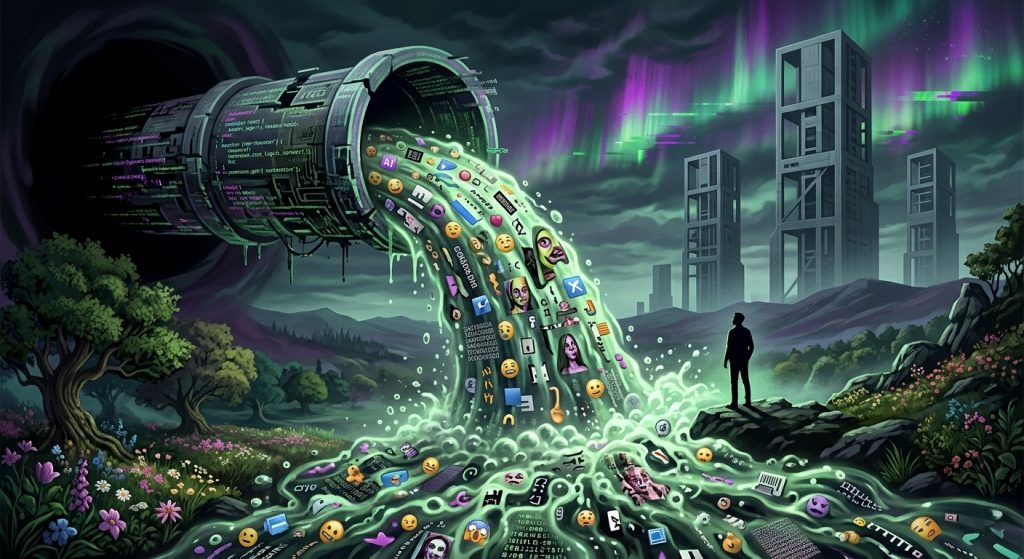
From bizarre images of “Jesus made of shrimp” to fake historical photographs, fictional influencers, and AI-generated “try this tool” ads, the modern social media experience is drowning in AI slop.
If you have scrolled through Instagram, Facebook, or X lately, you have likely noticed a subtle, unsettling shift in your feed. Amidst updates from actual humans, a tidal wave of hyper-polished, weirdly glossy, and utterly hollow content has taken over.
But this isn’t just an annoying trend or digital clutter. Tech giants like Meta and X are actively pushing this low-effort, automated junk into our feeds, and scientists are beginning to sound the alarm. We are witnessing the systematic pollution of our digital reality—and it is affecting both human psychology and the future of technology itself.
What is “Slop” and Who is Pushing It?
Coined as the digital equivalent of “spam,” AI slop refers to mass-produced, low-quality content generated by artificial intelligence with minimal human oversight. It isn’t created to inform or entertain; it is generated purely to farm clicks, views, and ad revenue.
The platforms aren’t just letting it happen—they are driving it:
- Meta has openly embraced this future. Executives have explicitly stated their intention to fill feeds with a “whole new category” of AI-generated content, even experimenting with fully automated AI user profiles that post fake life updates.
- X (formerly Twitter) has integrated its own AI directly into the user interface, prompting users to generate synthetic images and text summaries with a single click, flooding the global timeline with unverified, chaotic noise.
By tweaking their recommendation algorithms to boost engagement at all costs, these platforms have turned our feeds into digital feed troughs, shovelling endless streams of synthetic filler for us to passively consume.
The Human Cost: Implanting False Memories
While it is easy to laugh at a poorly rendered AI image with seven fingers, the psychological impact on humans is incredibly serious. Recent academic studies show that our brains are uniquely vulnerable to this visual pollution.
A 2024 study published on arXiv found that exposure to AI-edited images and videos significantly increases false human recollections. When users were shown altered AI media, their likelihood of forming a completely fabricated memory spiked by over 200% compared to the control group. (arXiv)
The Human Cost: Implanting False Memories
While it is easy to laugh at a poorly rendered AI image with seven fingers, the psychological impact on humans is incredibly serious. Recent academic studies show that our brains are uniquely vulnerable to this visual pollution.
A 2024 study published on arXiv found that exposure to AI-edited images and videos significantly increases false human recollections. When users were shown altered AI media, their likelihood of forming a completely fabricated memory spiked by over 200% compared to the control group.
The “Gist-Based” Trap: Human brains naturally use “gist-based processing”—we lock onto the overall narrative of a picture or story rather than analysing the individual pixels. When we are scrolling casually, our critical faculties are lowered. We absorb the vibe of the fake image, accept it as truth, and subconsciously alter our memory of real-world events. (Deborah Ko – Medium)
Academics at the University of Oxford have labelled this phenomenon “careless speech.” Unlike deliberate disinformation, which has a specific political agenda, slop is just automated “bullshit”—content generated with zero regard for truth. Because there is no human logic behind the errors, they are actually harder for us to predict and spot. (Khazanah Research Institute)
The AI Suicide Pact: Model Collapse
The pollution doesn’t stop with human psychology; it is also poisoning the AI models themselves.
To train more advanced AI systems, tech companies use automated web-scrapers to ingest billions of pages of data from the internet. But because the open web is now completely cluttered with AI slop, new models are accidentally being trained on the waste excreted by older models.
Computer scientists call this catastrophic feedback loop Model Collapse (or “AI Cannibalism”).
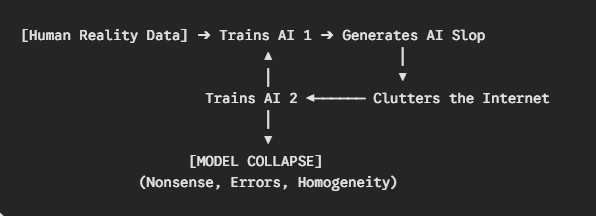
When an AI trains on human data, it learns the rich, diverse, and nuanced edge cases of human culture. But when it trains on slop, it only replicates statistical averages. Within a few generations of an AI copying an AI, the system degrades entirely—producing garbled text, compounding factual errors, and rendering deeply distorted images.
By pushing slop to maximise short-term ad metrics on Instagram and X, Big Tech is actively poisoning the very data wells they need to build the future of computing.
Environmental and Cultural Bankruptcy
Renowned AI researcher Kate Crawford recently described AI slop as a form of “metabolic media.” These systems require astronomical amounts of electrical energy, land, and fresh water just to run the data centres that excrete this endless stream of digital detritus.
We are quite literally burning real-world fossil fuels and consuming planetary resources to generate digital garbage that actively degrades human memory and tech infrastructure.
The internet used to be a mirror of human experience—a place to connect with friends, share genuine creativity, and document real life. By turning the digital town square over to automated slop engines, Meta and X are making the internet fundamentally unusable.
It is time to stop scrolling past the slop on autopilot. If we don’t start demanding human authenticity from our platforms, we will wake up to a world where reality itself has been permanently diluted.
Can AI Tell the Difference?
The short answer is sometimes, but it is a losing battle. When an AI model looks at text or an image, it doesn’t have “intuition” or common sense. It looks for mathematical patterns.
Where AI is good at detecting slop: AI can easily spot certain artifacts. In text, it detects a lack of vocabulary variety, overly predictable sentence structures, and the overuse of generic transition words (like Furthermore, In conclusion, or Delve). In images, computer vision models can catch geometric errors, unnatural textures, or impossible lighting.
Where AI fails: As generative models get better, the mathematical gap between a human-written paragraph and an AI-written paragraph shrinks. If the slop is polished enough, an automated filter cannot definitively tell it apart from basic human writing.
Because billions of pages of AI slop are uploaded daily, it is physically and computationally impossible for AI companies to manually vet every single piece of data their web-scrapers pull in.
The Harvest: “Model Collapse” and Data Poisoning
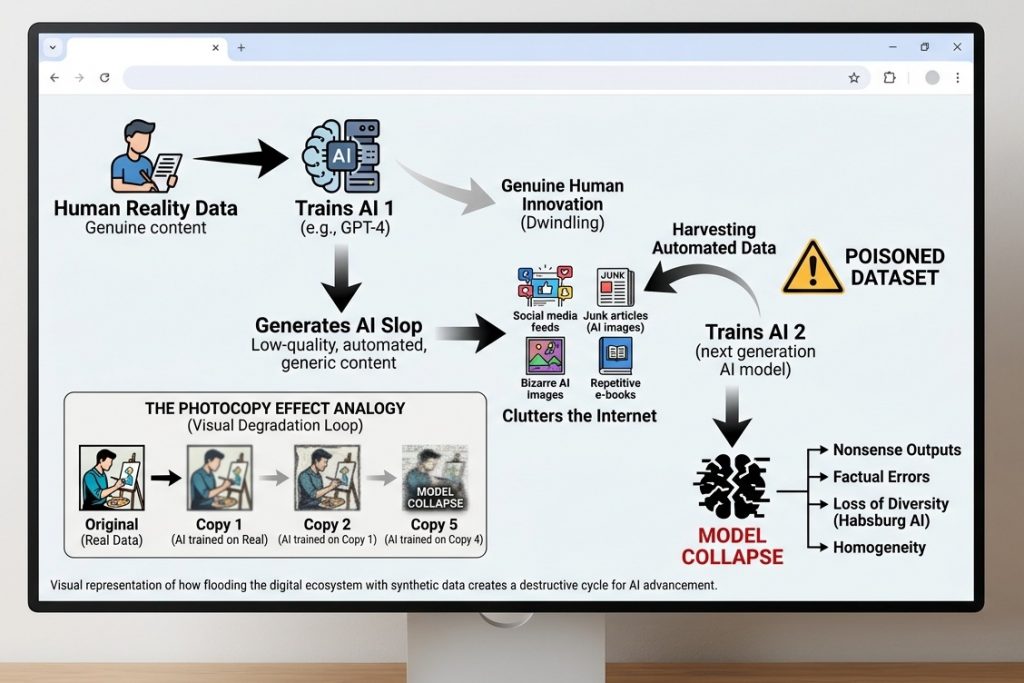
When web-scrapers blindly pull text and images from social media, blogs, and ad sections to train the next generation of AI, they are essentially harvesting their own waste. This creates a feedback loop that computer scientists call Model Collapse (or colloquially, “Habsburg AI” and “AI Cannibalism”).
Here is how that “pollution” destroys the technology from the inside out:
The Photocopy Effect: Think of training an AI on the internet like making a photocopy of a photograph. It looks great. But if you take that photocopy, put it on the glass, and make a copy of that copy—and repeat this for 5 to 10 generations—the final image becomes a blurry, distorted mess of black and white shapes.
1. The Loss of the “Long Tail”
When an AI trains on human data, it learns about rare edge cases, weird human subcultures, niche historical facts, and unique artistic styles (the “long tail” of data). But AI slop only repeats the most common, generic statistical averages. If an AI trains on slop, it quickly forgets that those rare, unique things exist, making the AI’s output incredibly boring and repetitive.
2. Compounding Mistakes
If one AI hallucinates a fake fact or renders a person with six fingers, and that slop is posted online, the next AI takes that as gospel truth. The errors compound exponentially until the model starts producing absolute nonsense—like a text model randomly shifting from a topic about history to a garbled rant about rabbits.
The Irony of the Slop Ecosystem
The ultimate irony is that tech companies are spending billions to build tools that users are deploying to flood platforms like Instagram and Facebook with junk. Then, those same tech companies scrape those platforms to build their next models, effectively poisoning their own well.
To build better AI in the future, companies are having to desperately look for “clean” datasets that were written before 2023, or pay premium prices for closed, verified human data (like licensing Reddit archives or newspaper repositories) because the open web is becoming too polluted to use.





You must be logged in to post a comment.